04 · The Heat Kernel Signature: diffusion as a local probe#
SpectralBrain tutorial series — notebook 4 of 10. (Previous: ShapeDNA.)
ShapeDNA gave one fingerprint for a whole structure. To find out where shapes differ we need a descriptor at every vertex. The Heat Kernel Signature (HKS; Sun, Ovsjanikov & Guibas 2009) does exactly that, by watching how heat diffuses away from each point across many time scales.
Learning objectives#
Define the HKS from the heat equation and the LBO spectrum.
See how scale (\(t\)) interpolates from local curvature to global shape.
Render HKS on the hippocampus and relate small-\(t\) HKS to curvature.
Make it scale-invariant with SI-HKS and prove the invariance.
1. Heat flow and the heat kernel#
Drop a unit of heat at a point \(x\) and let it diffuse over the surface according to the heat equation \(\partial_t u = \Delta u\). The amount of heat remaining at \(x\) after time \(t\) — the heat kernel evaluated on the diagonal — has a clean spectral form:
Read it as a recipe: each eigenfunction contributes its squared value, damped by \(e^{-\lambda_k t}\). The time \(t\) is a scale knob:
small \(t\) — only the highest frequencies have not yet decayed, so HKS senses the immediate neighbourhood: curvature and fine geometry.
large \(t\) — only the lowest frequencies survive, so HKS reflects the point’s place in the global shape.
Because it is built from \(\lambda_k\) and \(\varphi_k\), HKS inherits the LBO’s isometry invariance: it is intrinsic and pose-free, just like ShapeDNA, but resolved per vertex.
import sys
from pathlib import Path
sys.path.insert(0, str(Path.cwd()))
import numpy as np, matplotlib.pyplot as plt
import spectralbrain as sb
from _tutorial_utils import data_path

v, f = sb.load_gifti_surface(
    data_path("hippunfold", "sub03", "hemi-L_space-T1w_den-8k_label-hipp_midthickness.surf.gii"))
hipp = sb.BrainMesh(v, f)
dec = hipp.decompose(k=200)          # HKS wants more modes than ShapeDNA

# Principled time scales from the spectrum: t in [4 ln10 / λ_max , 4 ln10 / λ_1].
lam = dec.eigenvalues
t_min = 4 * np.log(10) / lam[-1]
t_max = 4 * np.log(10) / lam[1]
t_grid = np.logspace(np.log10(t_min), np.log10(t_max), 100)
hks = np.asarray(sb.compute_hks(dec, t_values=t_grid))
print(f"HKS matrix: {hks.shape}  (vertices x time-scales)")
print(f"time range: {t_min:.3g} ... {t_max:.3g}")
[06/09/26 02:00:22] INFO Laplacian (cotangent): N=8192, nnz=56578
HKS matrix: (8192, 100)  (vertices x time-scales)
time range: 3.54 ... 1.58e+03
2. One signature, many scales#
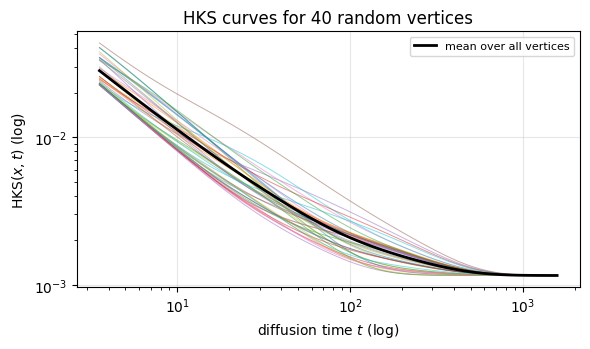
For a handful of vertices, plot HKS as a function of \(t\). Every curve is that point’s multi-scale identity card. Points in geometrically distinct locations (a tip vs a flat flank) trace different curves; the spread across vertices is largest at small \(t\) (local detail) and collapses at large \(t\) (everyone shares the same global shape).
rng = np.random.default_rng(0)
sample = rng.choice(hipp.n_vertices, 40, replace=False)
fig, ax = plt.subplots(figsize=(6, 3.6))
for idx in sample:
    ax.plot(t_grid, hks[idx], lw=0.7, alpha=0.5)
ax.plot(t_grid, hks.mean(0), "k-", lw=2, label="mean over all vertices")
ax.set_xscale("log"); ax.set_yscale("log")
ax.set_xlabel("diffusion time $t$ (log)"); ax.set_ylabel("HKS$(x,t)$ (log)")
ax.set_title("HKS curves for 40 random vertices"); ax.legend(fontsize=8); ax.grid(alpha=0.3)
plt.tight_layout(); plt.show()
3. The spatial pattern changes with scale#
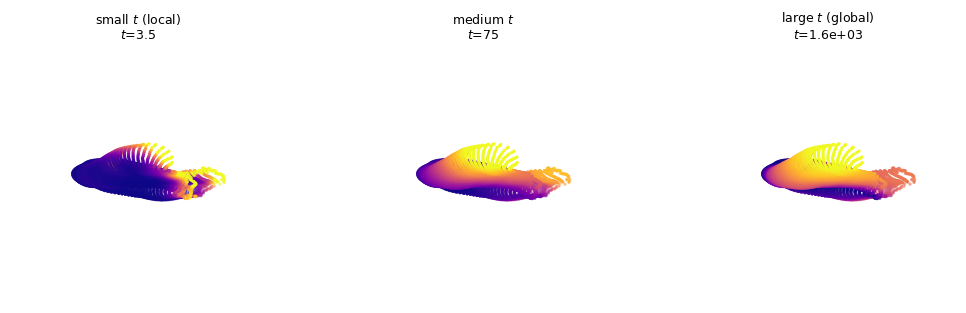
Now fix three scales — small, medium, large — and paint HKS across the surface. Watch the pattern reorganise: fine, curvature-driven structure at small \(t\) broadens into smooth, head-to-tail organisation at large \(t\).
t3 = np.logspace(np.log10(t_min), np.log10(t_max), 3)
hks3 = np.asarray(sb.compute_hks(dec, t_values=t3))

V = hipp.vertices
fig = plt.figure(figsize=(10.5, 3.2))
for i, (t, lab) in enumerate(zip(t3, ["small $t$ (local)", "medium $t$", "large $t$ (global)"])):
    ax = fig.add_subplot(1, 3, i + 1, projection="3d")
    s = hks3[:, i]
    ax.scatter(V[:, 0], V[:, 1], V[:, 2], c=s, cmap="plasma", s=2,
               vmin=np.percentile(s, 2), vmax=np.percentile(s, 98))
    ax.set_title(f"{lab}\n$t$={t:.2g}", fontsize=9); ax.set_axis_off(); ax.view_init(20, -70)
plt.tight_layout(); plt.show()
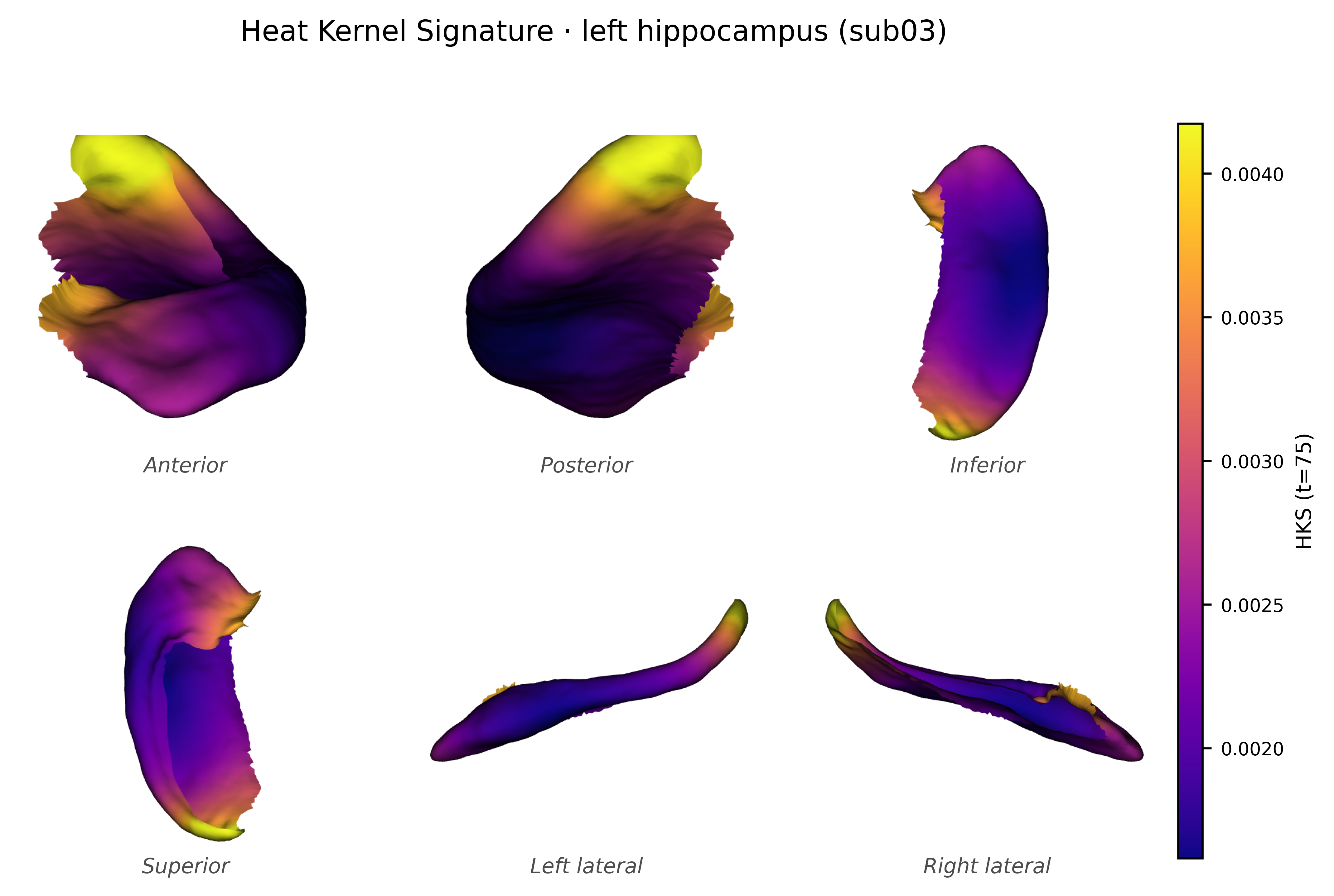
The same medium-scale HKS, rendered with the six-view tool — the kind of figure that goes into a paper.
from spectralbrain.viz import plot_surface_sixview
fig = plot_surface_sixview(hipp, scalars=hks3[:, 1], cmap="plasma",
                           scalar_bar_title=f"HKS (t={t3[1]:.2g})",
                           title="Heat Kernel Signature · left hippocampus (sub03)")
plt.show()
2026-06-09 02:00:28.159 ( 0.510s) [ 7F8673792080]vtkXOpenGLRenderWindow.:1460 WARN| bad X server connection. DISPLAY=
4. Small-\(t\) HKS is a curvature probe#
The short-time expansion of the heat kernel gives, to leading order,
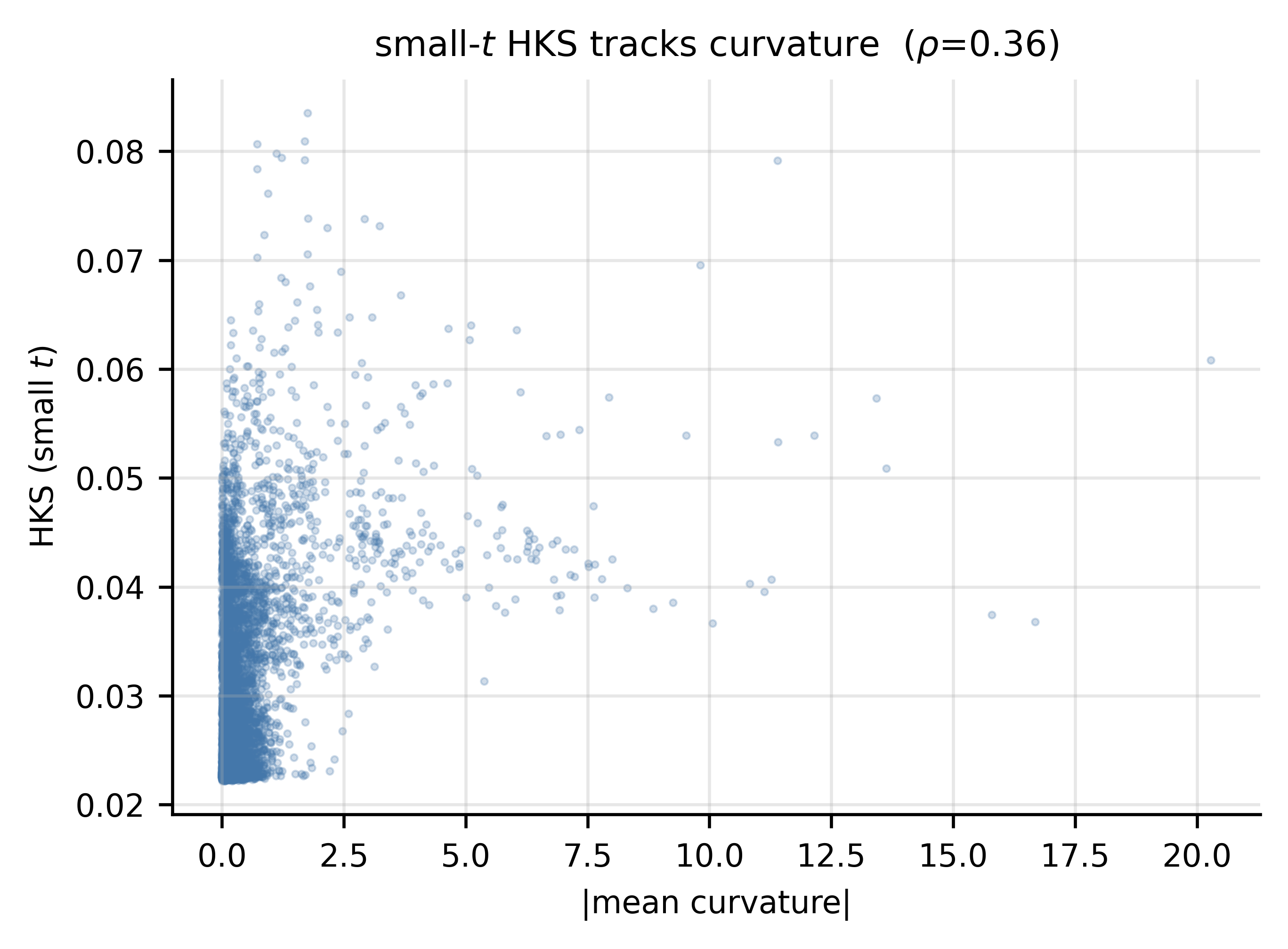
where \(S(x)\) is the scalar curvature (twice the Gaussian curvature on a surface). So at small \(t\), HKS should track curvature. We test it: correlate the smallest-\(t\) HKS column with the mesh’s own curvature estimate.
from scipy.stats import spearmanr
kmean = np.abs(hipp.mean_curvature())
rho, p = spearmanr(hks3[:, 0], kmean)
print(f"Spearman correlation (small-t HKS vs |mean curvature|): rho = {rho:.3f}, p = {p:.1e}")

fig, ax = plt.subplots(figsize=(4.6, 3.4))
ax.scatter(kmean, hks3[:, 0], s=3, alpha=0.25)
ax.set_xlabel("|mean curvature|"); ax.set_ylabel("HKS (small $t$)")
ax.set_title(f"small-$t$ HKS tracks curvature  ($\\rho$={rho:.2f})"); ax.grid(alpha=0.3)
plt.tight_layout(); plt.show()
Spearman correlation (small-t HKS vs |mean curvature|): rho = 0.355, p = 1.6e-242
5. The scale problem, and SI-HKS#
HKS has one weakness for cross-subject work: it is not scale-invariant. Scaling a shape by \(\alpha\) rescales every eigenvalue by \(1/\alpha^2\), which slides the HKS curve along the \(t\)-axis. Two hippocampi of identical shape but different size get different HKS.
The Scale-Invariant HKS (Bronstein & Kokkinos 2010) fixes this with a neat
trick: sample HKS on a logarithmic time grid (so a scale change becomes a
shift), then take the magnitude of the Fourier transform along that axis
(which is shift-invariant). compute_si_hks does this and returns a few
low-frequency coefficients per vertex.
big = sb.BrainMesh(hipp.vertices * 2.0, hipp.faces)     # same shape, twice the size
dec_big = big.decompose(k=200)

# Plain HKS at fixed t: shifts with scale.
hks_o = np.asarray(sb.compute_hks(dec,     t_values=t3))
hks_b = np.asarray(sb.compute_hks(dec_big, t_values=t3))
print("plain HKS, mean value per scale:")
print(f"  original : {hks_o.mean(0)}")
print(f"  scaled x2: {hks_b.mean(0)}   <- different")

# SI-HKS: stable across scale (vertex order is preserved, so compare per-vertex).
si_o = np.asarray(sb.compute_si_hks(dec))
si_b = np.asarray(sb.compute_si_hks(dec_big))
corr = [np.corrcoef(si_o[:, j], si_b[:, j])[0, 1] for j in range(si_o.shape[1])]
print(f"\nSI-HKS per-frequency correlation (original vs scaled): "
      f"min={min(corr):.3f}, mean={np.mean(corr):.3f}")
print("-> SI-HKS is (nearly) invariant to the 2x rescaling; plain HKS is not.")
[06/09/26 02:00:32] INFO Laplacian (cotangent): N=8192, nnz=56578
plain HKS, mean value per scale:
  original : [0.02813216 0.00244451 0.00115613]
  scaled x2: [0.02352424 0.00166222 0.00032007]   <- different

SI-HKS per-frequency correlation (original vs scaled): min=1.000, mean=1.000
-> SI-HKS is (nearly) invariant to the 2x rescaling; plain HKS is not.
Exercises#
Scale sweep. Plot mean HKS vs \(t\) for the original and the \(2\times\) mesh on the same log axes. Confirm the curve shifts horizontally by the predicted amount (\(\Delta\log t = \log \alpha^2\)).
Mode budget. Recompute HKS with
k=50, 100, 200modes. At which scale (\(t\)) does the number of modes matter most — small or large \(t\)? Why?Curvature, properly. Replace
mean_curvaturewithgaussian_curvaturein section 4. Which curvature does small-\(t\) HKS track more tightly, and does the short-time expansion explain it?Subfield contrast. Render HKS at small \(t\) on the hippocampal tail surface from notebook 2 and compare its curvature structure to the full hippocampus.
Descriptor as feature. Take the full HKS matrix (100 scales) for
sub03_Landsub04_L, average over vertices, and measure the Euclidean distance between the two mean-HKS curves. How does it compare to their ShapeDNA distance from notebook 3?
What’s next#
HKS is a low-pass descriptor: heat diffusion smooths away high frequencies. Notebook 05 introduces the Wave Kernel Signature, which uses the Schrödinger equation to build a band-pass descriptor with sharper frequency localisation, plus the Global Point Signature embedding. Together they round out the per-vertex descriptor toolkit before we turn to correspondence and statistics.